Wednesday, February 23, 2011

iRead recap: Dr. Susan Schoenbohm

Susan Schoenbohm was the iRead guest speaker on February 22, 2011. Dr. Schoenbohm is currently the Practice Leader at the Nashville Zen Center. She has taught philosophy at the University of the South and Penn State University, and she teaches Buddhism in the religious Studies Program at Vanderbilt.

Dr. Schoenbohm’s talk was about the history, philosophy, and practices of Buddhism. She explained that there are different forms of Buddhism with different understandings of its teachings. Zen Buddhism is a form of Ch’an which practices Dhyana, sitting meditation, to learn the teachings of Buddha which can not be learned through words or doctrine. Like Buddha, enlightenment can be gained through meditation practices. She brought with her a statue of Buddha and explained in Zen philosophy it is a symbol of meditation. In other Buddhist traditions the statue of Buddha is revered in veneration of the enlightenment experience. However, Buddha is not considered a god and did not claim divinity.

Buddhism was born in Northern India and the early practices drew upon Hindu worship. As it spread throughout Asia, it took different routes and developed different forms. The early teachings of Buddha were transmitted orally and memorized by nuns and monks. Later they were written down but ultimately there were many variations in the teachings. There are two major branches of Buddhism, Theravada, and Mahayana. Mahayana tradition includes seated meditation and does not focus on the writings, but emphasizes what Buddha himself practiced. Practice undergirds all of the teachings. The most important truth in Buddhism is the realization that everything is impermanent. After all of Buddha’s seeking, he could not find anything that lasts forever.

Buddha was a Prince, Siddhartha Gautama, who was destined to be a holy man. His father did not want this so he protected him with a lavish lifestyle and kept him sheltered from the world. One day Buddha wonders from the palace and sees poverty, disease, old age, and death. He is inspired to understand suffering and goes on a spiritual journey in which he develops a philosophy based on Four Noble Truths. The First Noble Truth is called Dukkha meaning bitterness of life and its dissatisfying nature as it is always undergoing impermanence. The Second Noble Truth is the cause of life’s dissatisfactions, clinging to impermanent things. The Third Noble Truth is Nirvana. It is the cure for clinging and leads to freedom from entanglement with impermanent things. Seated meditation, as Buddha practiced, is itself enlightenment. The Fourth Noble Truth is the Eightfold Path, the practice of right thought and finding a balance.

During her talk, Dr. Schoenbohm led a short meditation session for the group. We focused on straight posture, breathing, and freeing our minds from thoughts. By practicing a lot, she told us, we can quiet our minds from fears, hopes, desires, and expectations. Through meditation we can develop understanding and compassion by realizing that we are all interconnected and that loss is inevitable.

Tuesday, January 25, 2011

Door Prize Winners!

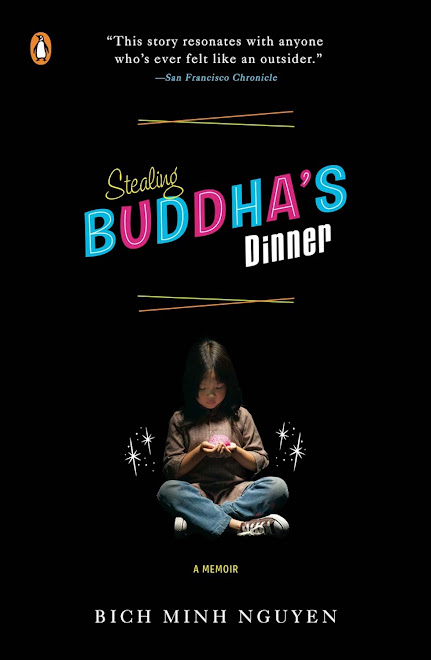
Congratulations to Ryan Critchelow, Alissa Klein, and Scott Miller, the latest winners of our Stealing Buddha's Dinner door prizes!

Vise Library sponsored a photographic exhibition for its fourth iRead program on the book, Stealing Buddha’s Dinner. Mr. Bernie Ash, professional photographer and owner of Creative Photography on the Square in Lebanon was our featured artist. Mr. Ash began by setting the context of the times when he was 18 years old in 1965 and a recent graduate from Lebanon High School. Martin Luther King, Jr. was leading the Civil Rights movement, the cost of the average home was $13,000, and you could buy a cup of coffee for 5 cents. The War in Vietnam was being fought and young boys approaching 18 had to decide what to about the War. Some got married and others went to college to defer their service. Others were drafted and sent to fight in the infantry. It was a heavy decision. Many men stepped up and did not wait to be drafted. Bernie was one of these young men. He joined the Air Force and with one year of service left, he received orders to go to Vietnam for 12 months. Since he had a desire to become a preacher, he asked to be assigned as a Chaplain’s Assistant. Chaplains could not carry weapons so he travelled with the Chaplain to provide protection. He was sent to the Central Highlands of Vietnam, Phu Cat, near the South China Sea. It was great – except for the War!

During the Vietnam War 58,000 American soldiers were killed and 350,000 were wounded. Mr. Ash read the names of 15 young men from Wilson County who lost their lives. Several of these men were friends of his in high school, and one of them was an African American who was one of the first students to integrate Wilson County Schools. Over 2 million Vietnamese were also killed.

Mr. Ash carried an M-16 and a camera with him and took photographs of the people and places he saw on his tour of duty in Vietnam. He went with the Chaplain to visit villages, churches, and missionaries where they were helping people displaced by the War. As he guarded the jeep, he took photographs of the children he observed. Some not only lost their families, but their arms and legs as well. The “Girl with the Doll” (below) was taken as the little girl was leaving a missionary. She shows great joy in receiving this prize treasure. The other children in the photographs are all also smiling and playing like children everywhere. Even though they are living in a war zone, there is hope and innocence in their eyes.

Mr. Ash’s photographs, Children of Vietnam, will be exhibited in the Library until March 31, 2011.


Monday, January 24, 2011

Reminder!

iRead is tomorrow at 12:30 PM in the library. Local photographer, Bernie Ash, will be here to talk about his photographs of Vietnam. We will also have a reception with food and drinks. Be sure to join us!

Wednesday, January 12, 2011

Spring Events

Two events have been scheduled for the spring semester:

On January 25, local professional photographer Bernie Ash will speak about his photographic exhibit- Children of Vietnam. This event will take place at 12:30 in the Lawlor Room of the Vise Library.

On February 22, Susan Schoenbohm, practice leader at the Nashville Zen Center, will talk about the history, philosophy, and practices of Buddhism. This event will take place at 12:30 and is tentatively scheduled in Baird Chapel in Memorial Hall.

Look for more information about these events as they get closer!

Thursday, November 18, 2010

Presentation from November 16 iRead session

Jose Gonzales from the Coalition for Education about Immigration has shared his presentation from the November 16 iRead session. Click here to view the slides.

Wednesday, November 17, 2010

iRead recap: Jose Gonzales from the Coalition for Education about Immigration

Jose Gonzales from the Coalition for Education about Immigration (CEI) was the featured speaker. CEI’s mission is to provide the community with clear and accurate information that will help people adopt reasonable, fact-based conclusions about the immigration debate. He provided us with some interesting information about the immigrants in the United States and Tennessee.

In 2005 there were 35 million immigrants which are about 12% of the total population representing diverse social, religious and cultural backgrounds. Immigrants are from many nations and about half of them are from Latin America. Most are young, married, have jobs, and half report speaking English very well. A large percentage is in the United States legally as permanent residents or naturalized citizens. Only a small percentage are undocumented.

The majority of foreign born residents are Latino which is the largest and fastest growing minority in the United States. They participate in the economy by working, consuming products and services, and paying taxes, and they are active in the politics as both public servants and voters. More tortillas are sold in America than hot dogs and salsa outsells ketchup!

There are many myths about immigrants such as they are taking away jobs from other Americans and they come here to get on welfare and take advantage of social programs. Mr. Gonzales informed us that unauthorized immigrants are not eligible for these services. Additionally, unauthorized immigrants who have jobs are given a special identification number to pay income taxes and social security withholdings, even though they are not eligible for benefits. Furthermore, many immigrants are entrepreneurs and have their own business which brings jobs to the community.

Many immigrants come to Tennessee for the same reasons as those who are born in the United States: jobs, moderate weather, and good quality of life. They often leave their home countries due to undesirable economic or other bad conditions. Globalization of labor trends is another push factor. When the North American Free Trade Agreement (NAFTA) was passed by Congress, American agricultural products flooded the Mexican market. Many farmers could not compete so they left to find work on farms in the United States.

Mr. Gonzales ended his presentation with information about the Dream Act. Many children of undocumented immigrants come here at a young age and attend school from kindergarten to graduation with a high school diploma. Even though they have lived here most of their lives, they are not eligible to attend college. The Dream Act would allow them to adjust their legal status to be here legally. If passed, this legislation would enable many bright young immigrants to achieve their dream of a college degree.

This was the last iRead session for the fall semester. The sessions for the spring semester are in the final planning stages and will be announced as soon as they are finalized. The library staff would like to thank everyone who has attended the sessions so far, and we look forward to another semester full of great programs and speakers!